Assessment uses a handheld device with low, medium, and high lumen settings.
Used as a tool to demonstrate patient’s subjective glare symptoms when best corrected visual acuity testing does not reflect the severity of their cataract.
1. Ensure room light is dimmed or off.
2. The device is placed over one of the patient's eyes, so the small opening is centered over the visual axis. The contralateral eye is occluded
3. The patient is asked to focus on the Snellen eye chart through the device's opening.
4. Lumens are steadily increased and the best visual acuity is measured.
5. Functional vision impairment is demonstrated when decreasing acuity occurs with increasing lumens.
Glare is associated with Posterior Subcapsular and Anterior Cortical cataracts.*
*Especially in patients with miotic pupils.
Reduced contrast sensitivity
Poor Contrast Sensitivity
Common presentations
- Difficulty reading in dim lights.
eg, reading a menu in a dimly lit restaurant.
- Frequent falling, tripping, or balancing issues on uneven ground.
Due to reduced ability to use contrast as a depth perception tool.
Assessment
- Subjectively measured by testing best corrected visual acuity with letters at 10 - 11.2% contrast.
- Patients routinely have BCVA of HM or LP in the affected eye.
Comprehensive Evaluation
- Fundus exam, OCT macula, and B-scan should be attempted to inform further management decisions.
Narrow Angles
Narrowed Angles
Evaluation
- Patient and family history should be taken into consideration.
- Gonioscopy required for formal evaluation and diagnosis.
Intervention
Lens extraction can be offered as first line management.
- In place of peripheral iridotomy.
To prevent angle closure glaucoma progression, even in patients with clear lenses.
EAGLE Study
Compared clear lens extraction to peripheral iridotomy (standard) Found those in the lens extraction group had...
- Lower rates of irreversible glaucomatous blindness progression - Lower mean IOP - Greater quality of life - More cost effective management
Azuara-Blanco et al. The Lancet 2016.
Explanation
Non-Cataractous Lens
- Preipheral iridotomy provides aqueous outflow from ciliary body to anterior chamber.
Effectiveness is still dependent on patency of trabecular meshwork and canal of schlemm.
- The inherent shape of our native, non-cataractous, lens can still impede on the trabecular meshwork's patency - more than the shape of an implanted lens can (when placed properly).
Cataractous Lens
- As the cataract progresses, the lens thickens and pushes against the iris.
- This causes anterior displacement of the iris leading to narrowed angles and a shallow anterior chamber.
Increasingly narrowed angles are most commonly seen during the progression of Nuclear Sclerotic Cataracts.
Lens Dislocation
Lens Dislocation
Phakic
Anterior and posteriorly dislocated phakic lenses require surgical intervention
- Prevent secondary inflammation - Provide anisometropic relief
An aphakic contact lens can be used if surgery is to be avoided.
Pseudophakic
- Lenses that are displaced may need urgent surgical intervention if causing damage to other structures (cornea, angle, retina)
Clinically Significant Anisometropia
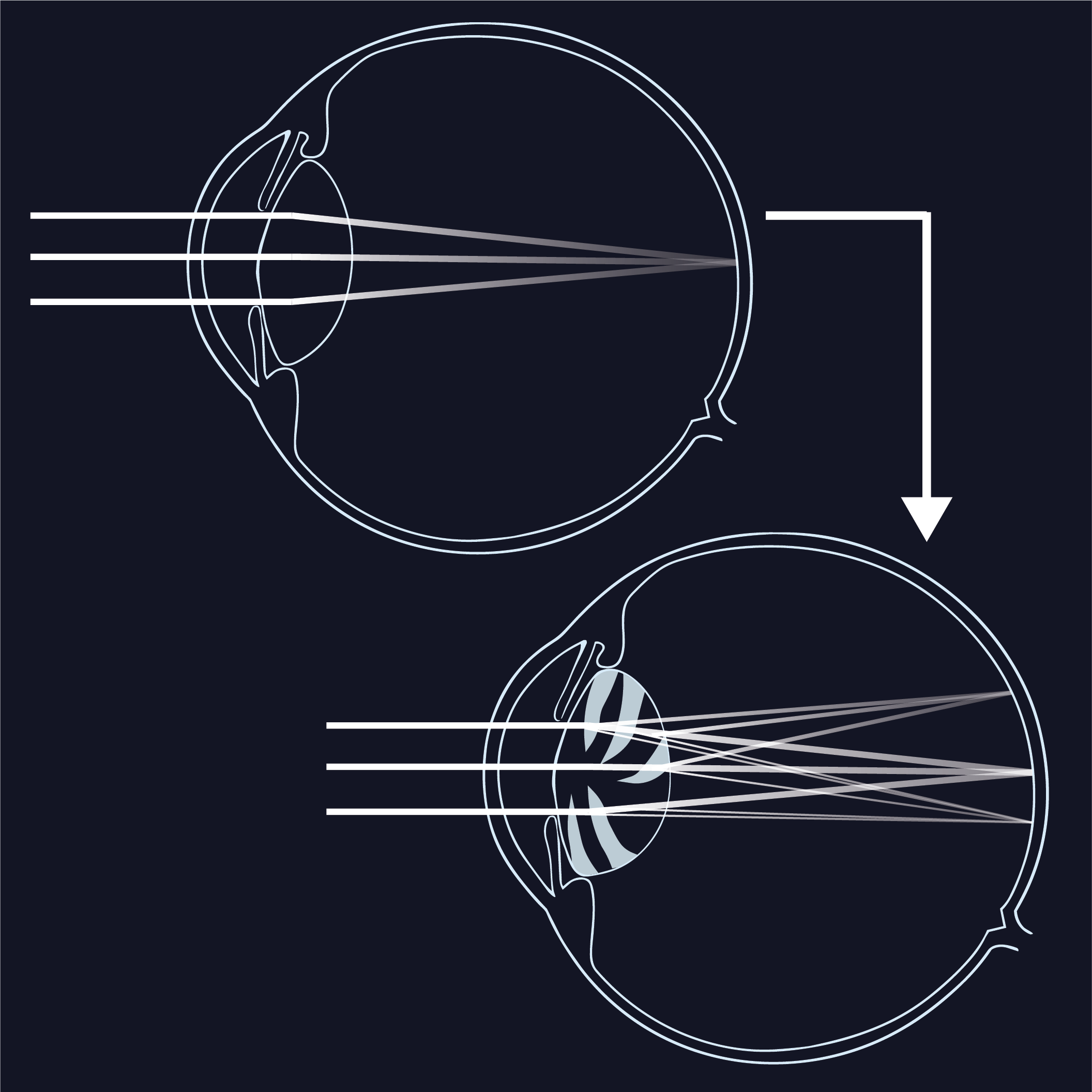
Anisometropia
Definition
- Patient's eyes have ≥ ~2.00 Diopter difference in refractive power.
AC: Presence of lens material, ± synechiae, ± cell/flare
Cornea: Edematous,absence of keratic precipitates
AC: Cell ± pseudohypopion
Lens: Mature/hypermature cataract
Gonio: Open angles
Cornea: Cloudy, edematous
AC: Cell/flare
Lens: Intumescent cataract
Gonio: Angle closure
Pathogenesis
Granulomatous autoimmune response to lens antigen.
[IgG + Compliment mediated]
Lens particles released into AC Obstructs TM.
[Due to compromised lens capsule]
Lens proteins leak into AC. Inflammatory cells + lens protein clog TM.
[Due to mature cataract]
*lens capsule ≠ compromised.
Angle closure and pupillary block from progressively enlarging lens.
[Due to cataract progression, esp NSC]
Monocular Patient
Monocular Patients
Suggested Management
- Surgical intervention should be scheduled as soon as the cataract is visually significant.
Explanation
- Reduces risk of intra and postoperative complications associated with later stage cataracts.
Contraindications
Ongoing Inflammation, Infection, or Poorly Controlled Pathology
Inflammation, Infection, or Poorly Controlled Pathology
Inflammation
- Autoimmune and drug responses should be resolved.°
Infection
- Ongoing, involving globe/orbit.‡
Pathologies
Cornea
- Pathologies that prevent adequate view to intraocular structures.
Diabetic
- Macular edema, rubiosis, retinal hemorrhages.
°Consider additional postoperative prophylactic medication and/or prolonged course for patients on chronic immunosuppressants and immunomodulators. ‡Abx course completed, infection resolved, prior to preoperative appointment measurements. *Lens induced inflammation and glaucoma are exceptions to these contraindications.