Topography + Tomography  

Corneal masurements for lens selection and intraoperative considerations

Topo | Atlas 9000 | Tomo | Pentacam | Galilei G4/G6

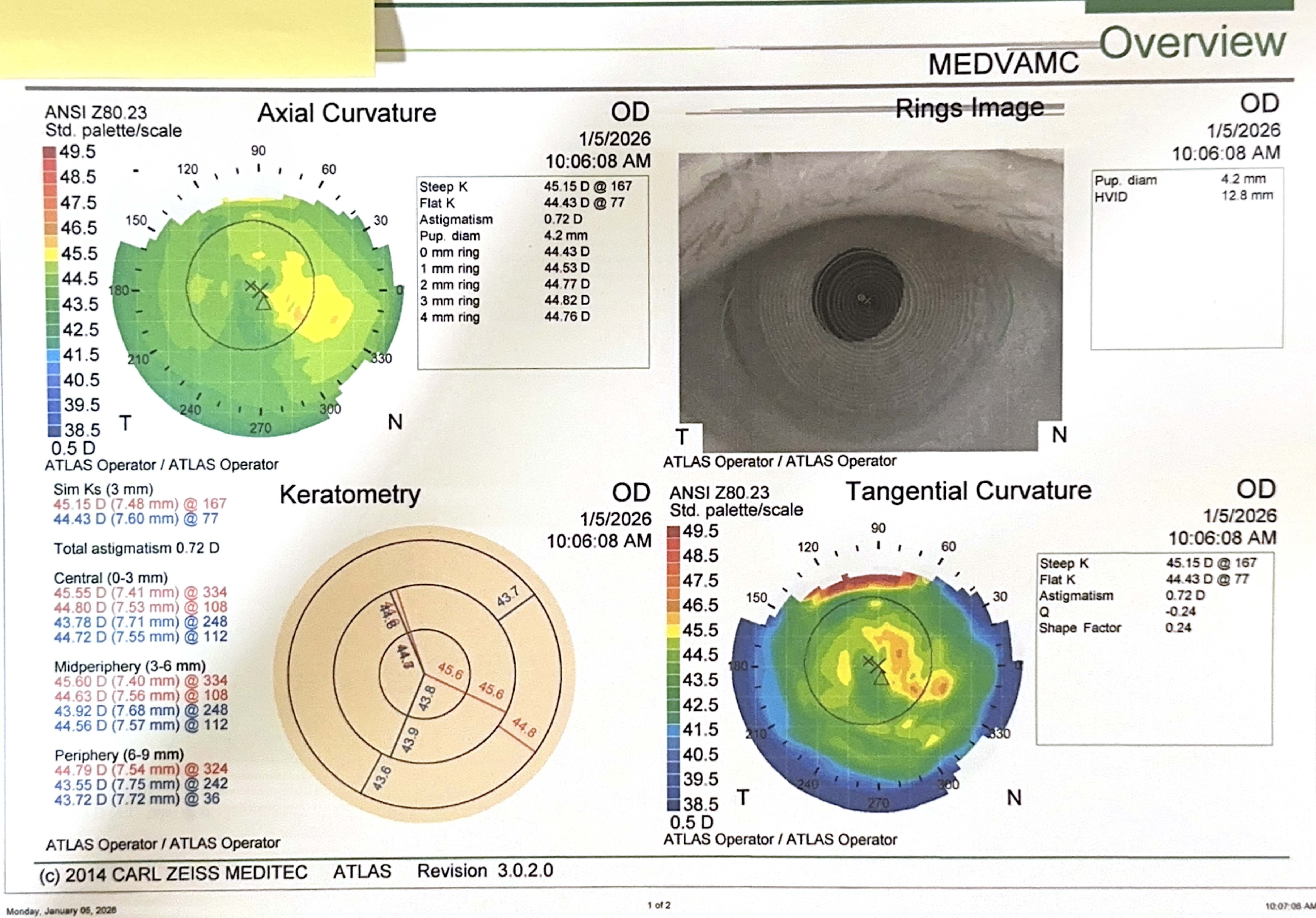
Topography | Atlas 9000

Placido based topographer.

- Maps the anterior corneal surface curvature via keratoscopic rings (mires).

Detects shape of corneal surface, evaluates tear film and corneal surface.

Measures include

K1: Flat meridian

K2: Steep meridian

Km: Averages of K1 and K2

Astigmatism: Difference between K1 and K2

Q-value: Vector direction and steepness of cornea

Tomography | Pentacam & Galilei G4/G6

Maps the anterior and posterior corneal surface curvatures.

Maps 3D image of the cornea, enhances ability to detect ectasias.

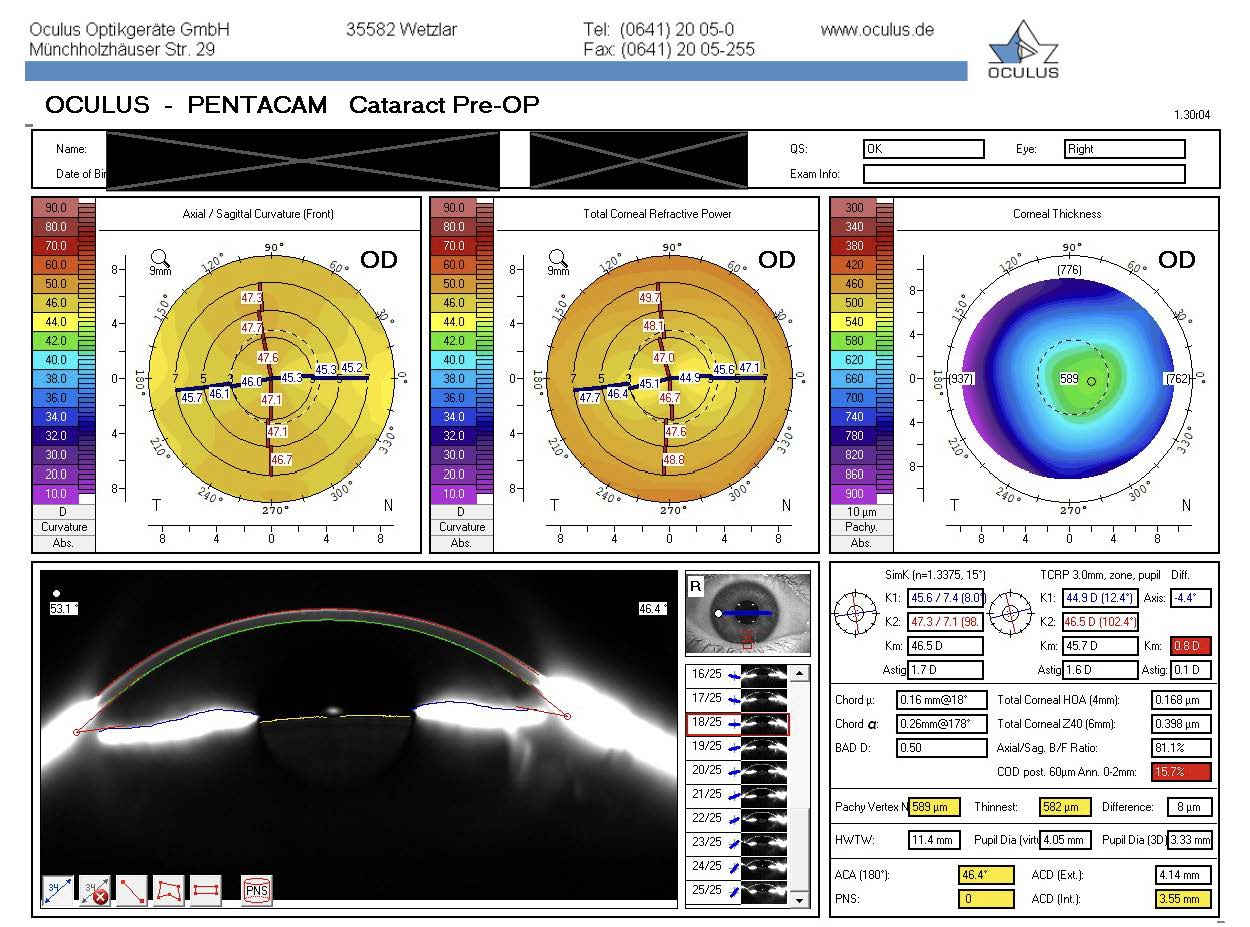
Pentacam

- Uses Schiempflug based tomographer.

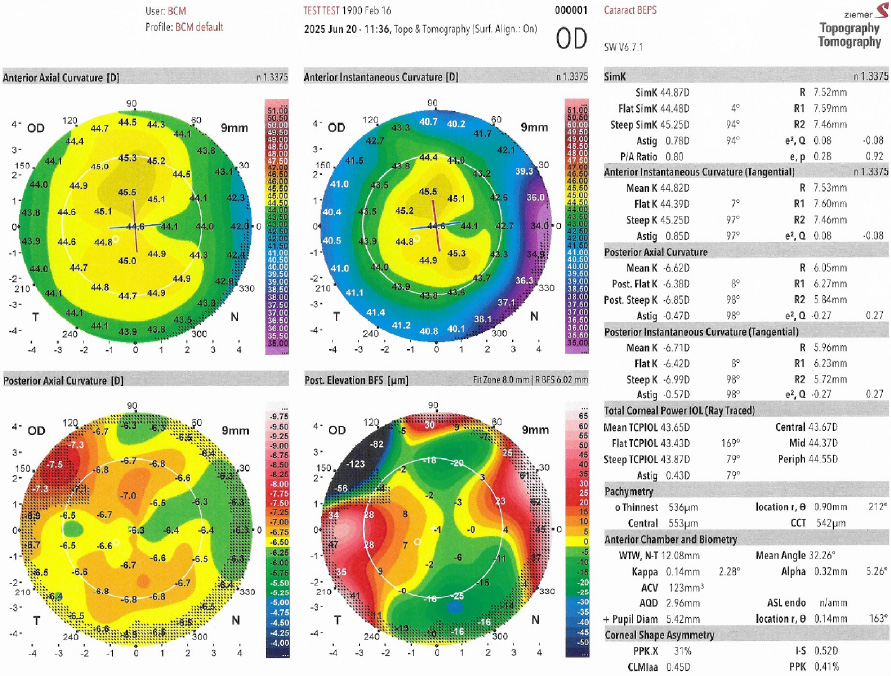
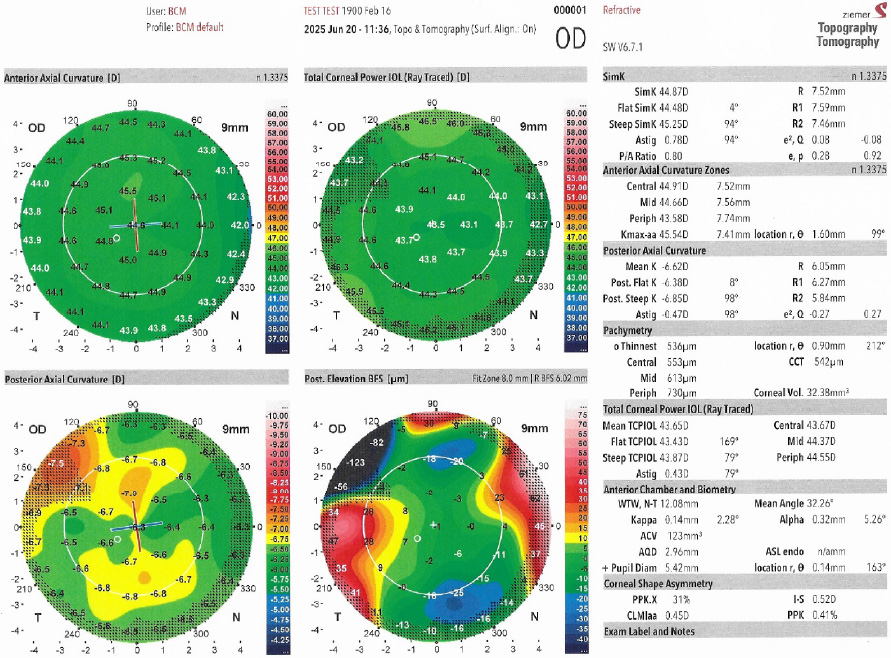
Galilei G4/G6

- Uses a dual Schiempflug based tomographer (has 2 rotating cameras) + Placido based topographer.

Includes all topographic measures and the following

Posterior & Anterior Elevation Data

Corneal Pachymetry across the cornea

Total Corneal Refractive Power

Kmax

Corneal Optic Density score (Pentacam)

Angle 𝛼

Angle 𝜅

Higher Order Aberrations - Including Spherical Aberrations
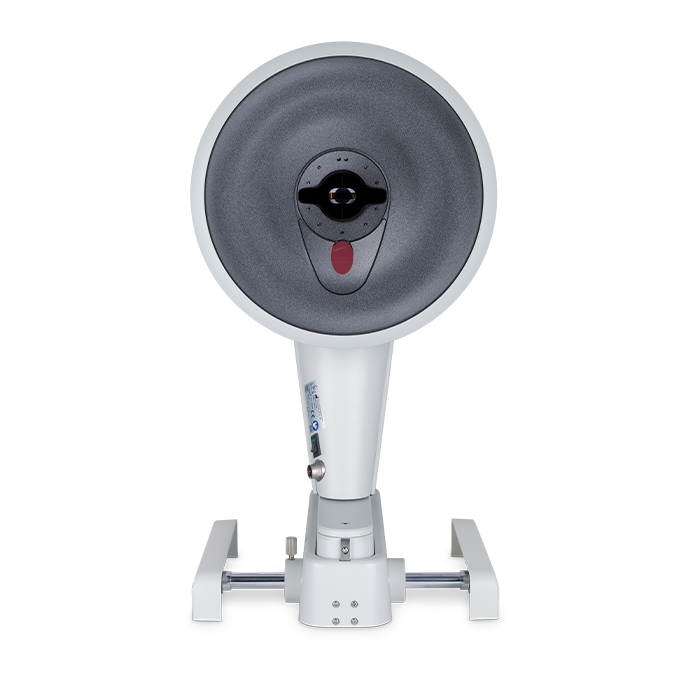
Pentacam
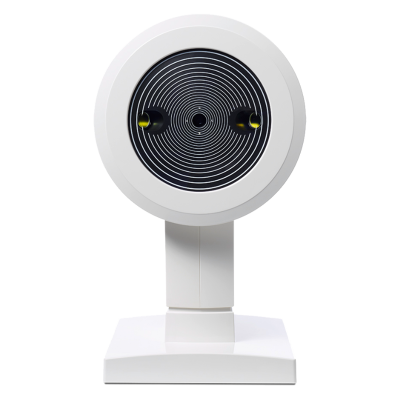
Galilei G4/G6

Key Concepts

Corneal Optics

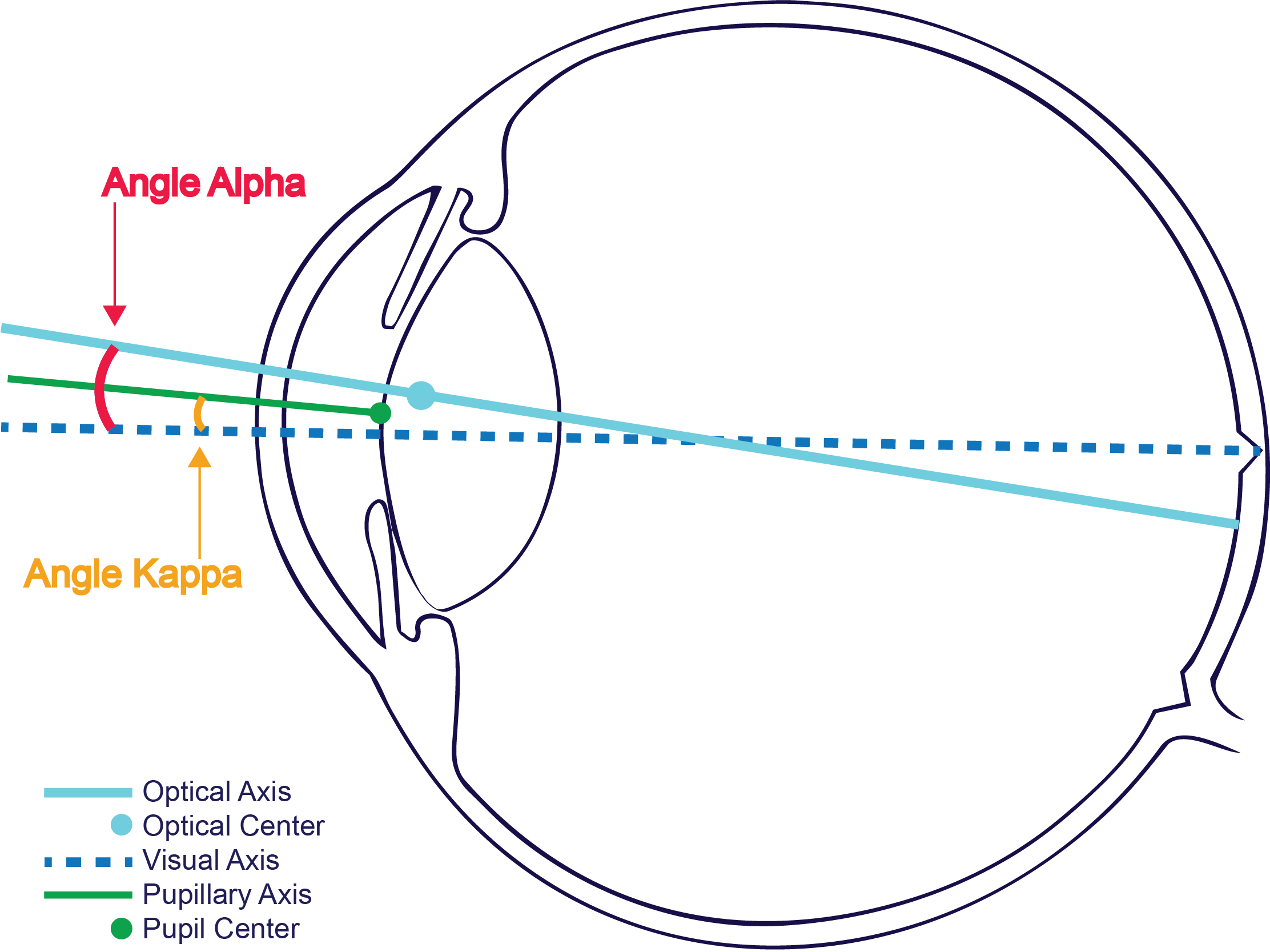
Optical Axis

(Solid Teal Line)

Axis at which light would pass through the cornea and lens to focus light at the back of the eye

- If all structures were perfectly aligned and angled with respect to one another.

Passes through the optical center (teal dot).

Visual Axis

(Dashed Blue Line)

Axis at which light actually passes through the cornea and lens to focus on the fovea.

Pupillary Axis

(Solid Green Line)

The ray that originates at the center of the pupil (green dot) and intersects the cornea perpendicularly.

Angle 𝛼

(Red Angle)

Distance between visual axis and optical axis.

Relationship with adverse photopic phenomenon in DO-ATIOLs.

≥ 4mm: Associated with increased photopic phenomena & decreased subjective visual quality after multifocal/EDoF/Trifocal implantation.

Jing et al 2022, Wang et al 2020.

Angle 𝜅

(Orange Angle)

Distance between pupillary axis and visual axis.

Does not influence subjective visual quality or patient-reported photopic phenomena after DO-ATIOL implantation.

Angle Kappa...Liu et al 2024

DO-ATIOLs = Diffractive Optic Advanced Technology IOLs.

Aberrations

Occur when light rays passing through a lens do not meet at the same point.

Corneal Aberrations

Etiology:

Anterior Corneal Surface >>> Posterior Corneal Surface.

- ∆ in refractive index: Air-Cornea >> Cornea-Aqueous Fluid.

Result:

(+) Spherical Aberrations

- Peripheral rays meet anterior to central rays.

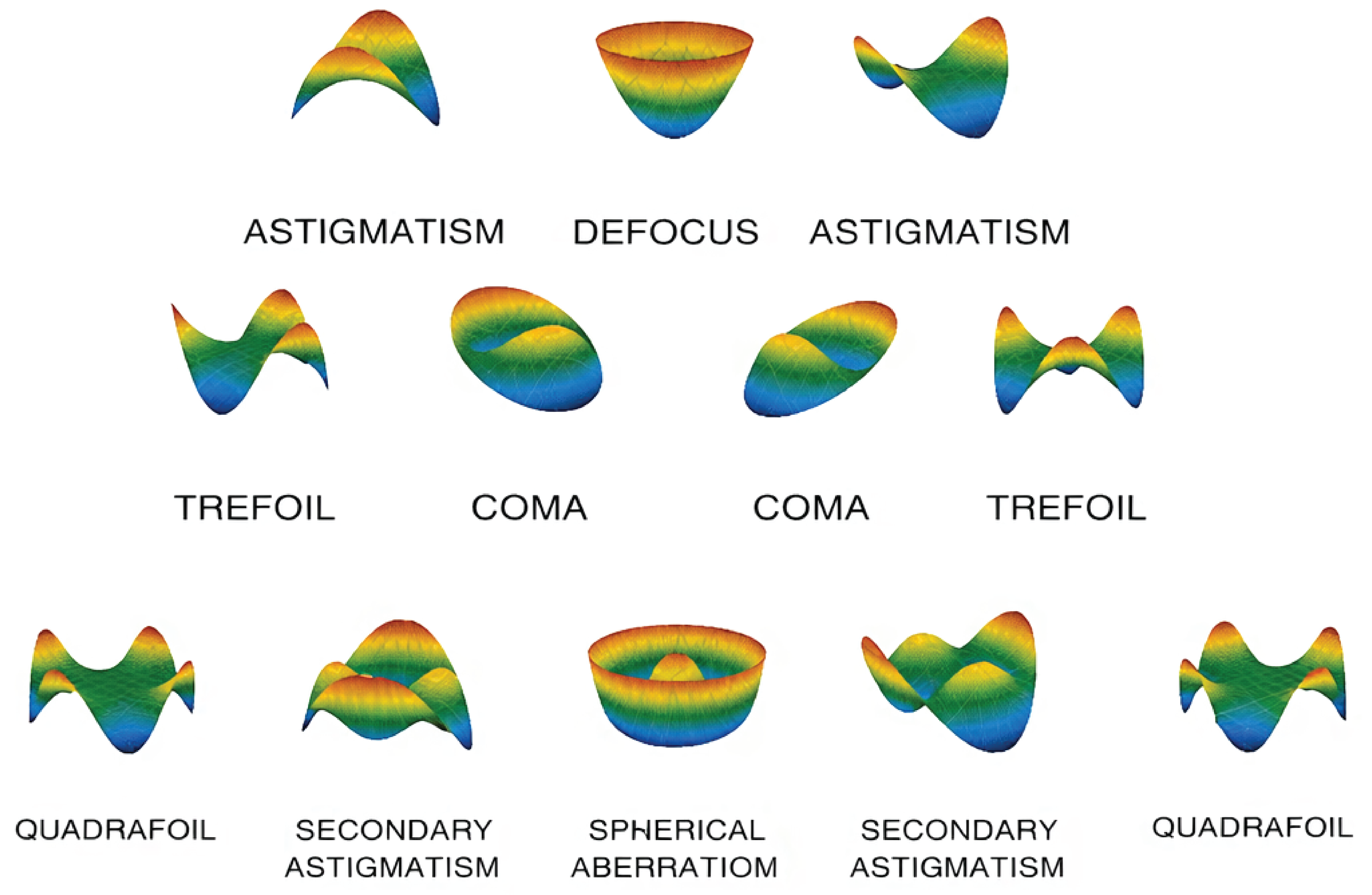
Lower vs Higher Order Aberrations

Lower Order | Correctable

- Defocus & Regular Astigmatism.

Higher Order Aberrations | Uncorrectable

- Trefoil, Coma, Spherical Aberration, Secondary Astigmatism, & Quadrafoil.

Crystalline (Native) Lens

(-) Spherical Aberration.

- Compensates for (+) spherical aberrations of cornea.

Compensation reduces due to age-related changes.

→ Halos, glare, starbursts occur, in part, due to net increase in (+) spherical aberration.

Aberrations

Q-Value & Spherical Aberrations

Q-Value:

Sphericity or shape of the anterior corneal surface.

Spherical Aberration (SA):

Result of peripheral and central light rays passing through anterior corneal surface (primarily) and converging at varying distances.

Changes from Myopic Refractive Surgery

Flattens central cornea.
→ Q value becomes more (+).
→ Increases (+) spherical aberration.

Negative spherical aberration IOLs are best.

Changes from Hyperopic Refractive Surgery

Steepens central cornea.
→ Q value becomes more (-).
→ Induces (-) spherical aberration.

Neutral or spherical aberration IOLs are best.


Topography

K1 = Flat Meridian.

Within the Central 3mm of Cornea

Power of flat meridian (in diopters).

- Illustrated as blue lines perpendicular to/between concentric rings of increasing diameter.

- Normally ~90º from steep meridian lines (which are in red)

*These meridian lines and concentric rings overlay the topographic maps on Pentacam.

K1, K2, Km, Kmax, Astigmatism, and Q-value are all assessments of the Anterior Corneal Surface only.

K2 = Steep Meridian.

Within the Central 3mm of Cornea

Power of steep meridian (in diopters).

- Illustrated as red lines perpendicular to/between concentric rings of increasing diameter.

- Normally ~90º from flat meridian lines (blue).

*These meridian lines and concentric rings overlay the topographic maps on Pentacam.

K1, K2, Km, Kmax, Astigmatism, and Q-value are all assessments of the Anterior Corneal Surface only.

Mean Steepness of the Central Cornea.

Km = Mean Anterior Corneal Power

Mean of K1 & K2 (in diopters)

Assumes

- Normal posterior cornea
- No prior refractive surgery

Normal: 40D-47D

K1, K2, Km, Kmax, Astigmatism, and Q-value are all assessments of the Anterior Corneal Surface only.

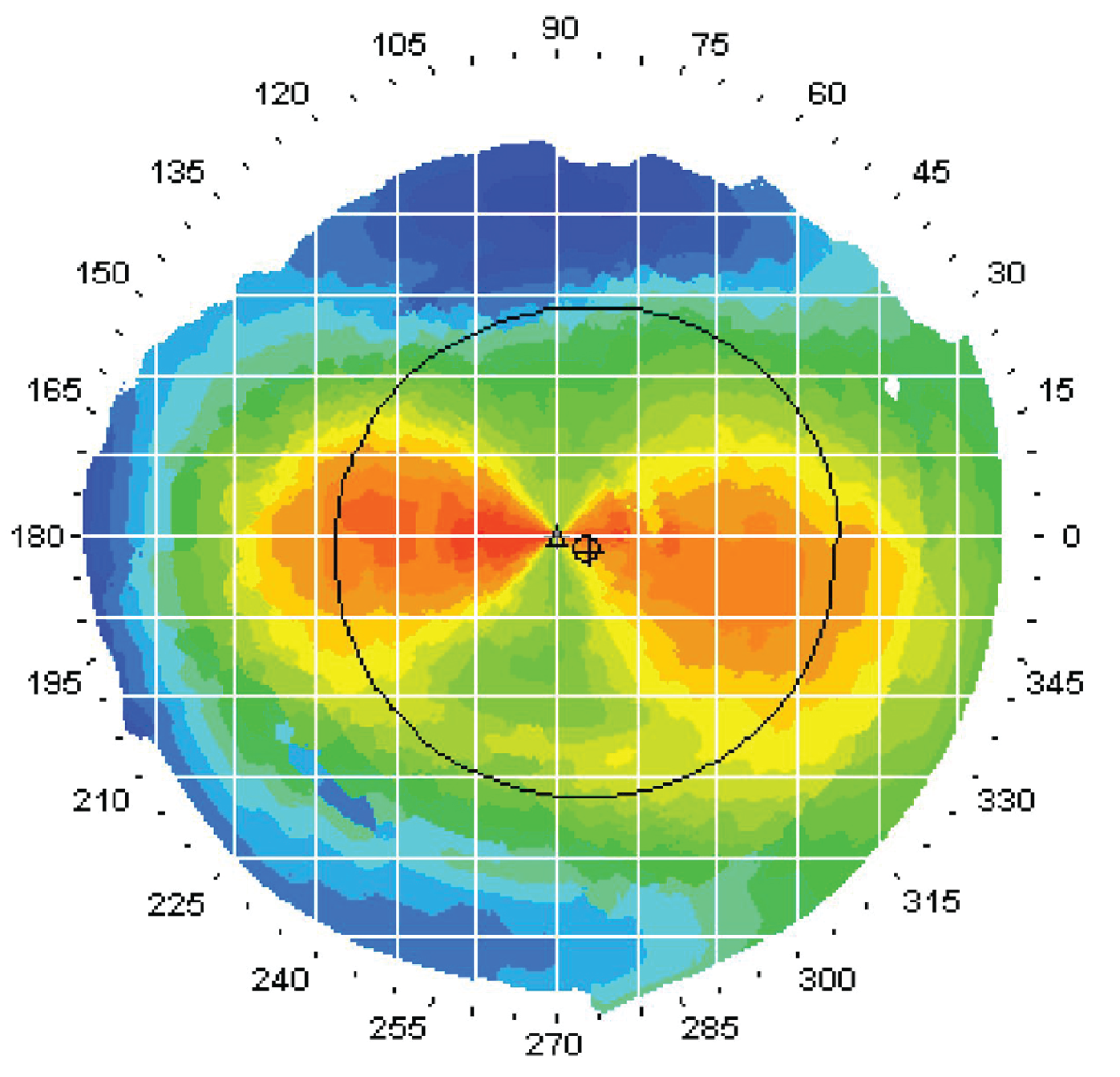
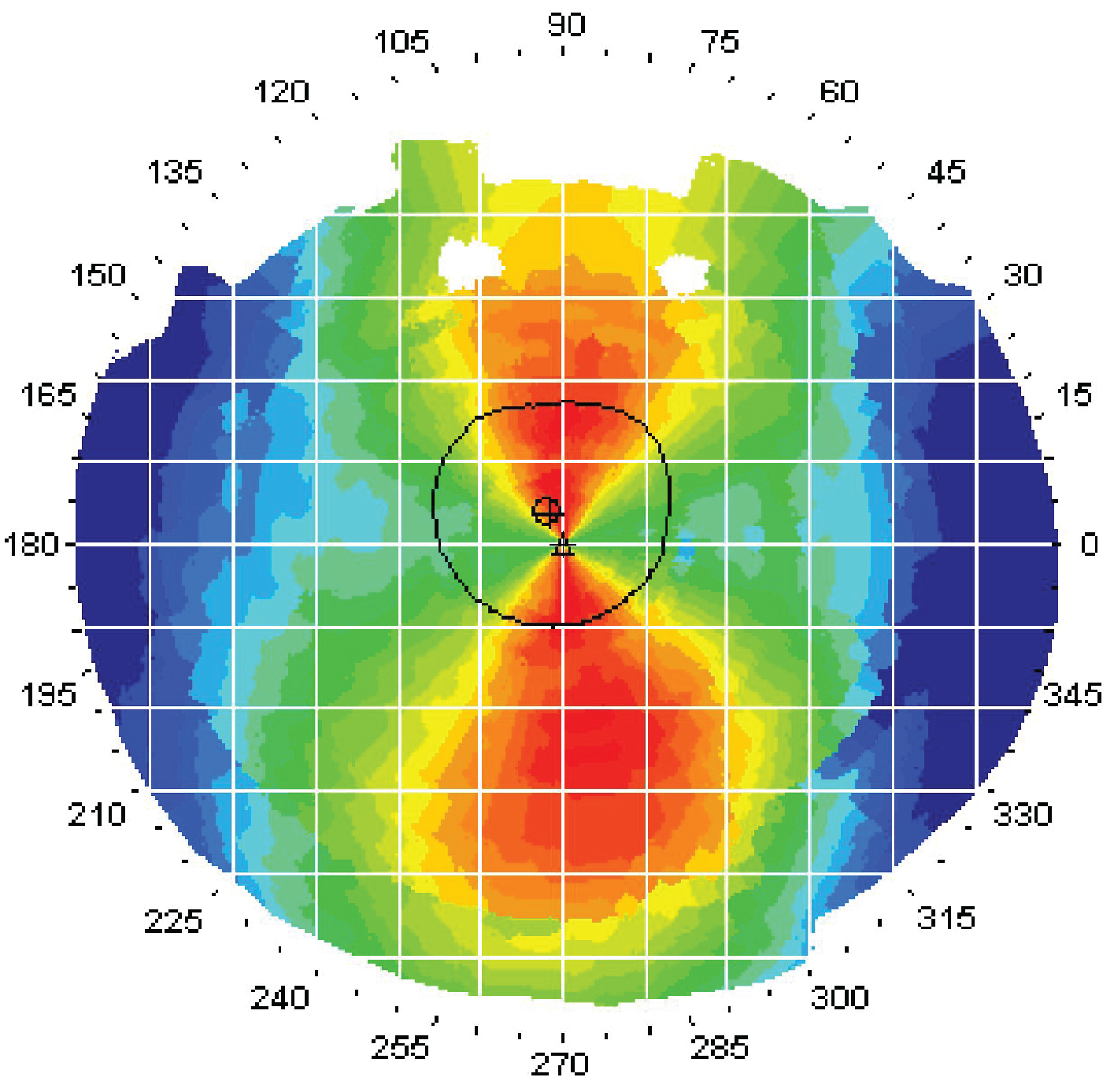
Difference between K1 and K2.

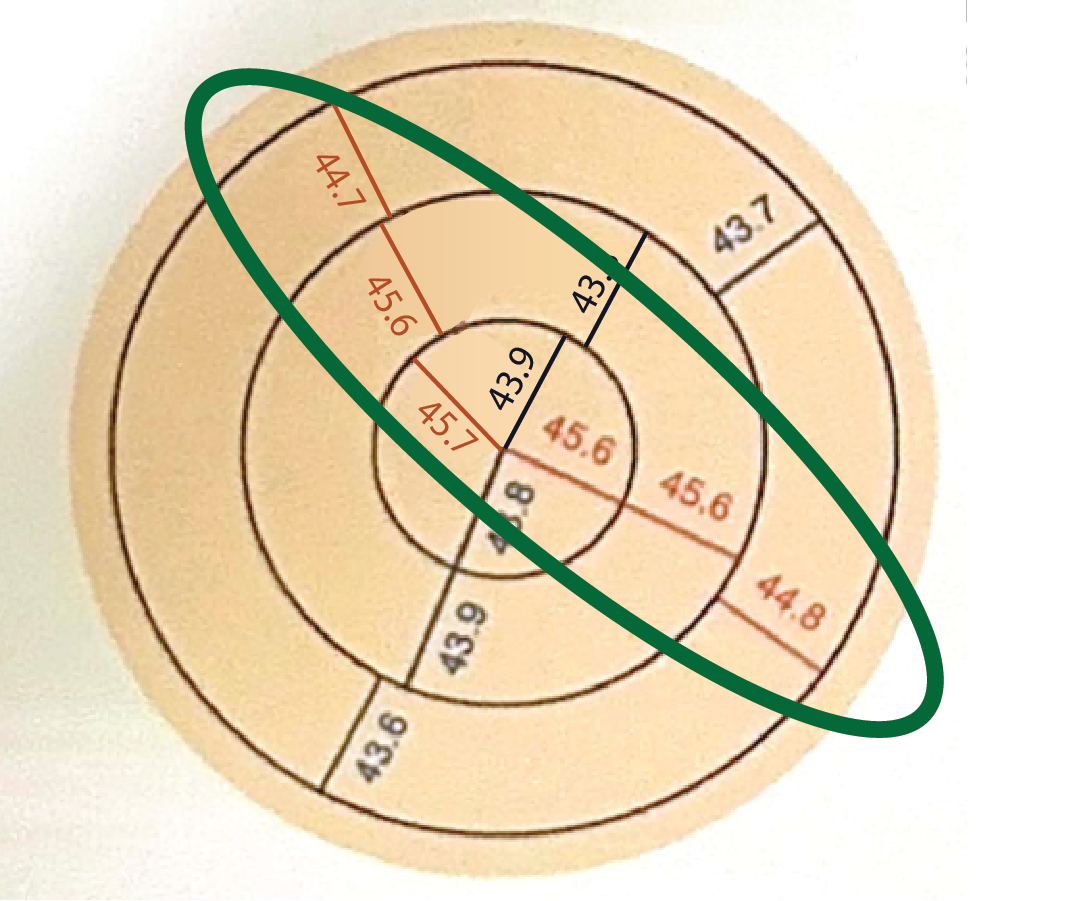
Against the rule astigmatism

- Steepest at the horizontal meridian.

ATR Ast. Vislisel J MD. EyeRounds.org. University of Iowa.

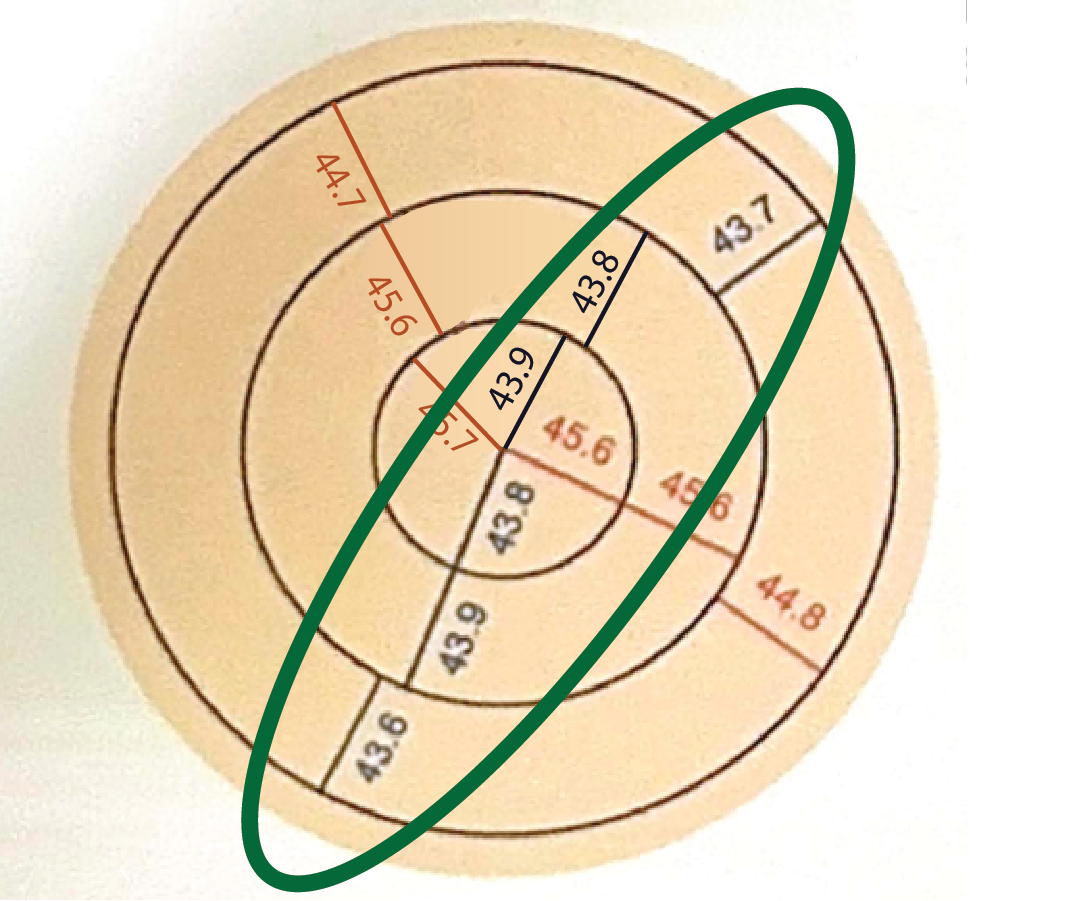
With the rule astigmatism

- Steepest at the vertical meridian.

WTR Ast. Vislisel J MD. EyeRounds.org. University of Iowa.

Regular Astigmatism

Toric lens candidate

- Symmetric steepening along meridian.

- Appears as a warmer-colored "bowtie" pattern with equal lengths on either side of the central axis on topography map.

Warmer colors indicate steep/vertical meridian (K2) on topography

ATR Ast. & WTR Ast. Vislisel J MD. EyeRounds.org. University of Iowa.

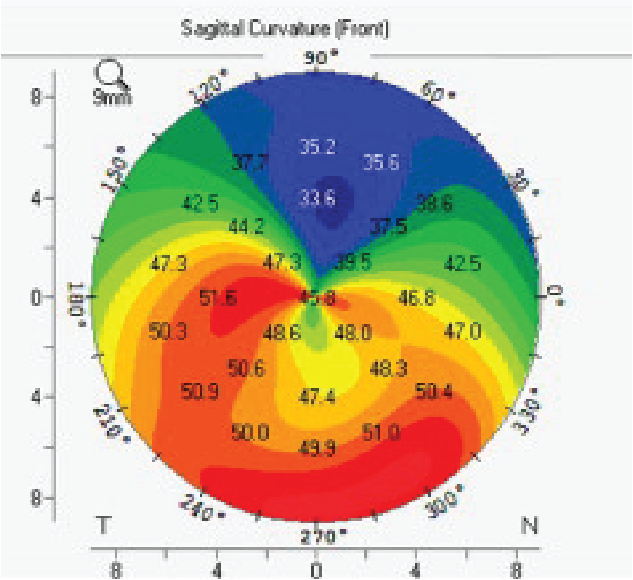
Irregular Astigmatism

Not usually toric lens candidate

- Asymmetric steepening along meridian.

- May appear as

- Warmer-colored "bowtie" pattern with unequal lengths on either side of the central axis on topography map.

- Warmer-colored areas with no identifiable pattern at all.

Keratoconus | Characteristic measurements

- Kmax: >47D
- Inferior-Superior (I-S) difference: >1.4D
- Asymmetric K: >0.92D
- Thinnest point of cornea ≠ central cornea
- Posterior elevation changes*
- Posterior elevation: >18-20µm

*Earliest indication of KCN


Starting your workflow with more insights. Zeiss.

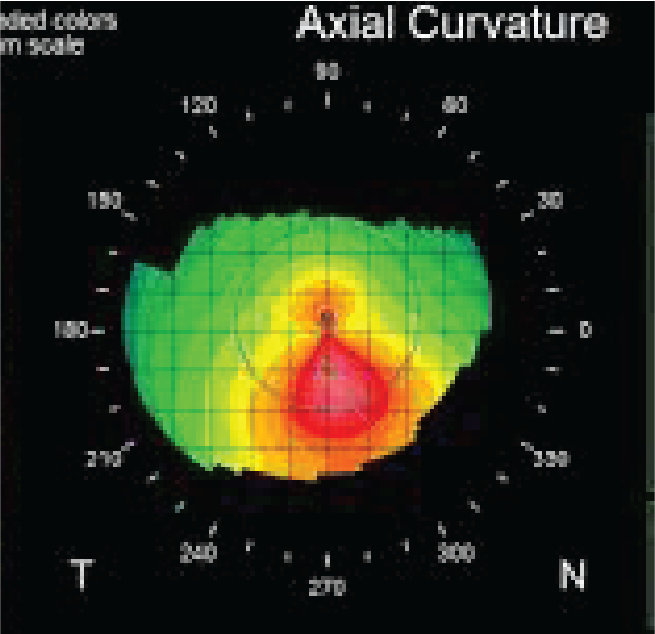
Pelucid Marginal Degeneration

- Peripheral and inferior thinning.

- Appears as a "claw shape" on axial curvature map.

Entokey.com

Measurement of Cornea Sphericity (shape).

Provides amount of aberration attributed to corneal curvature.

- Useful in determining whether multifocal IOL implant is an appropriate option for patients.

Normal: ~ (-)0.20 - (-)0.60

Negative Q-value: "Prolate"

- Correspond to steeper central and flatter peripheral corneal surfaces.

Positive Q-value: "Oblate"

- Correspond to flatter central and steeper peripheral corneal surfaces.

Atlas 9000


Tomography

Assesses Curvature of Cornea

Relative to Visual Axis.

Provides overview of corneal shape

Useful for identifying:

- Astigmatism and asymmetric patterns.

Warm colors: Steep

Cool colors: Flat

Height of Anterior Corneal Surface

Relative to Best-Fit Sphere.

Assess astigmatism regularity & location.

- Helpful for toric IOL planning.

Normal: +12µm

Abnormally elevated: >15µm

Image Interpretation

Warm colors:

- Anterior cornea's elevation is above best fit sphere.

Green:

- Anterior cornea's elevation fits the best-fit-sphere.

Cool colors:

- Anterior cornea's depression is below best fit sphere.

Applying other Maps to Anterior Curvature

Posterior elevation map:

- Difference should be <5µm.

Pachymetry map:

1. Locate thinnest point on pachy map
2. Corresponding elevation point on anterior curvature map should be...

- ≤8 in myopes
- ≤7 in hyperopes

Local Radius of Curvature at Each Point.

Detects small, localized shape changes

eg, Salzmann nodular degeneration, peripheral scarring.

Useful for identifying:

- Early ectatic diseases.

- Refractive surgery treatment zones.

Distribution of Corneal Thickness

Across Entire Measured Area/Cornea.

Locates thinnest point of cornea

Image Interpretation

Warmest color: Thinnest point.

Cool colors: Thicker areas.

Height of Posterior Corneal Surface

Relative to Best-Fit Sphere.

Refractive screening tool

Helps detect:

- Forme Fruste Keratoconus
- Early Keratoconus

Normal: +17µm

Abnormally elevated: >20µm

Image Interpretation

Warm colors:

- Posterior cornea elevation above best fit sphere.

Green:

- Posterior cornea elevation fits best-fit-sphere.

Cool colors:

- Posterior cornea depression below best fit sphere.

Applying other Maps to Posterior Curvature

Anterior elevation map:

- Difference should be <5µm.

Pachymetry map:

1. Locate thinnest point on pachy map
2. Corresponding elevation point on anterior curvature map should be...

- ≤18 in myopes
- ≤28 in hyperopes

Total Corneal Refractive Power.

Refractive power accounting for both anterior and posterior corneal surfaces.

Use TCRP instead of Km for

- Irregular astigmatism
- History of refractive surgery
- Toric IOL planning

Normal: 40D-47D

Not all IOL formulas can use TCRP.

< 3µm (Normal)

Does not restrict appropriate IOL

3µm-5µm

Appropriate IOLs: Monofocal or EDoF

Avoid: Multifocal

>5µm

Appropriate IOLs: Monofocal

Avoid: Multifocal and EDoF

Zernike Coefficient for Spherical Aberration.

(+)0.10 - (+)0.27µm

Normal  |  Mild to moderate positive SA

Appropriate IOLs: Aberration neutral or aspheric monofocal with slight (-) SA

>(+)0.3µm

High (+) SA  |  Post M-LVC  |  May reduce mesopic vision

Appropriate IOLs: Aspheric IOL with more (-) SA

Avoid: Spherical IOLs

<0µm

(-) SA  |  Post H-LVC  |  KCN

Appropriate IOLs: Spheric or neutral SA IOLs

Avoid: High (-) SA IOLs

Distance Between Visual Axis and Optical Axis.

Important for Evaluating Diffractive Lens Eligibility.

FYI:

Pentacam: Chord 𝛼 = Angle 𝛼

<0.3mm

Can use DO-ATIOLs in these patients.

0.3mm - 0.5mm

Difficult to predict outcome with DO-ATIOLs; caution with these patients.

>0.5mm

Avoid DO-ATIOLs (Ringed IOLs).

DO-ATIOLs = Diffractive Optic Advanced Technology IOLs.

Measurement of Light Scatter due to Corneal Haze.

≤ 20-25 GSU: Low

Does not restrict appropriate IOL.

25 - 40 GSU: Mild

Caution with ATIOLs in these patients.

>40-50 GSU: Severe

Avoid ATIOLs.

ATIOLs = Advanced Technology IOLs.

Tomography...

Tomography

Low Light, Mesopic Pupil Size.

Pentacam

Pupil (virtual): 2D image plane size

Pupil (3D): True anatomic entrance pupil

- Corrected for actual corneal curvature & geometry of eye.

More useful in refractive surgical planning.

Pentacam & Galilei G4/G6

Use in evaluation of...

- Corneal optical zone
- Angle alpha & kappa
- Centration decisions

Biometry

Bright Light at Time of Capture.
Provides Single Pupil Size.

IOL Master 700

Use in evaluation of...

- IOL Depth of Focus
- Glare/Halo
- Multifocal Tolerance